
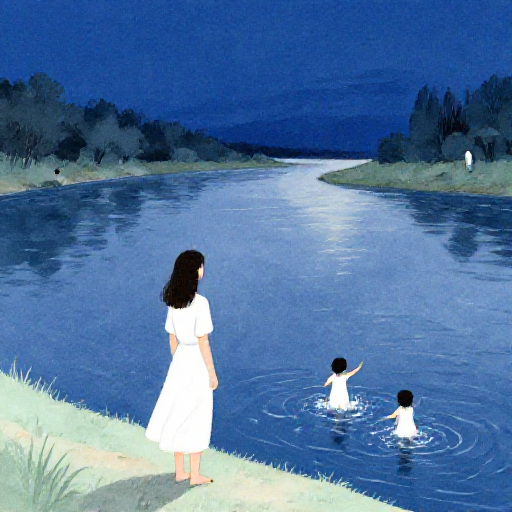
Chapter One: Before the River
She was beautiful. Every account agrees on this. Dark hair, white dress, the kind of face that made men rearrange their lives to be near her.
She loved a man who was wealthy and proud, and for a time that was enough. They had children together. Two of them. Small and dark-eyed and hers.
Then the man found someone else. A woman of his own class. There was to be a wedding.
He told her on a Thursday, near the river, while the children played in the shallows. He spoke carefully, the way men do when they have already decided and only need to say the words.
She watched him walk away. She stood at the river's edge for a long time after he was gone.
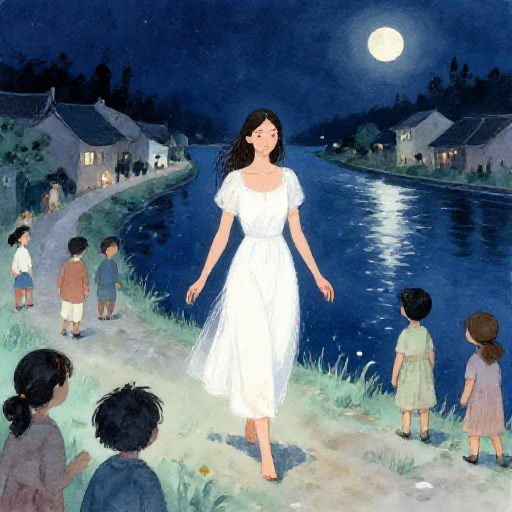
Chapter Two: The Water
No one saw exactly what happened. There are versions that say she wept first, for hours, and then something broke in her and the weeping stopped and what followed was very quiet.
The children did not come home that evening.
She walked into the village with her dress soaked through and her hair loose and her hands open at her sides. She said nothing to anyone she passed. She went to her house and lay down on the floor.
By morning she was dead.
Grief, some said. Others said something else.
The children were found downstream, tangled in the reeds. They were buried without her. No one thought to bury them together.
This was the first mistake.
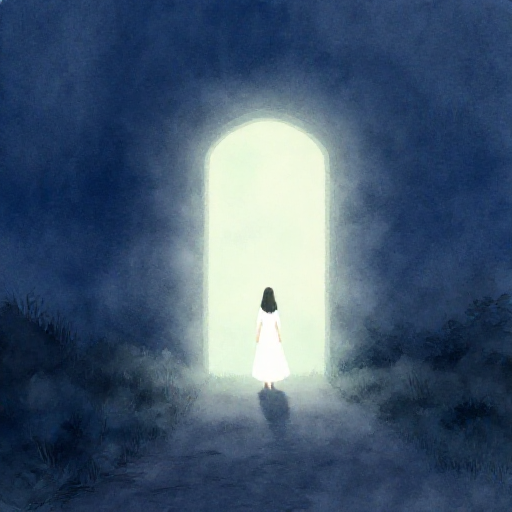
Chapter Three: The Gate
At the entrance to whatever comes after this life, she was stopped.
She came in white and soaking and she asked to enter, and she was asked: where are your children?
She did not know. She had not thought about that part.
She was turned back.
Go find them, she was told. Come back when you have them.
She returned to the river. She searched the banks in the dark, in her white dress, calling their names. She has been calling their names ever since. Two hundred years, some say. More. The accounts do not agree on when she first appeared. Only that she has always been there.
The river runs the same as it always did.
The children are not in it.
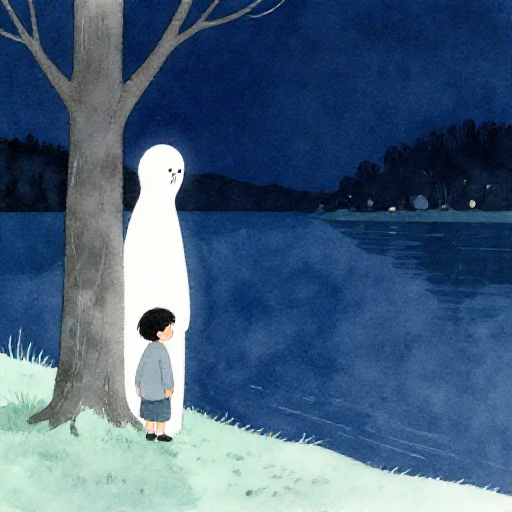
Chapter Four: The Sound
You will hear her before you see her.
A wail, distant at first. Mournful in a way that is difficult to describe accurately, because it is not only sadness. There is searching in it. There is something that might be rage at the edges, but mostly it is the specific sound of a woman looking for something she knows she will not find.
Here is what you must understand about the sound: it does not behave the way sound should.
When the wailing is far away, echoing and faint, she is close to you. When it is loud and near, she is somewhere else. This is not a riddle. This is how she works. Distance and nearness have rearranged themselves around her grief.
When the wailing stops entirely, she is standing right beside you.
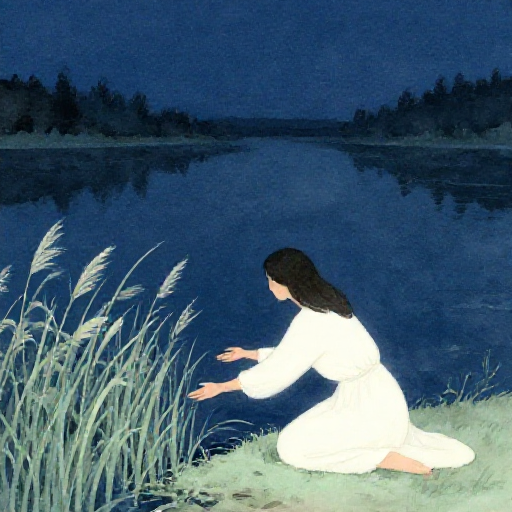
Chapter Five: The Children She Takes
She has been seen by thousands of people across centuries and a continent. The sightings are consistent: white dress, loose hair, the riverbank, the sound of weeping.
She is dangerous near water.
She is most dangerous to children who are out after dark. She has been known to mistake them, in the dark and in her grief, for her own. She does not do this maliciously. She is simply no longer fully present in the world of the living, and in her searching she sometimes reaches for what she cannot have.
Mothers in Mexico and the American Southwest have told this story to their children for generations. Stay inside after dark. Do not go near the water at night. If you hear crying that sounds far away, do not walk toward it.
The sound that seems farthest is the closest.
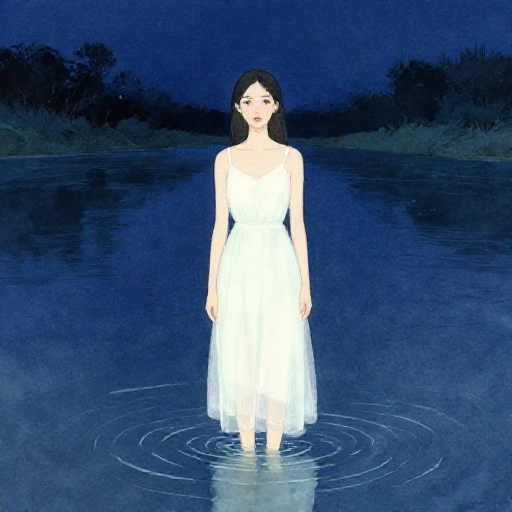
Chapter Six: The White Dress
She has been reported on the Rio Grande, the Colorado, the rivers of central Mexico, and dozens of unnamed creeks and irrigation channels. Urban neighborhoods. The edges of parks where there is no river but there was once. She follows water the way water follows low ground, because water was where everything ended for her, and she has not found her way past that night.
Sometimes she is seen in daylight. Pale, translucent, moving along a bank with her head down. She does not notice the living when the sun is out. She is looking at the water.
At night she is different.
At night she is looking at you.
She will not stop looking until you are out of sight, or until she decides you are not what she is searching for. Then the wailing starts again, and it is very loud, and you will know this means she has moved on.
You will be grateful for the loudness.
The True History
La Llorona, "the Weeping Woman," is one of the oldest and most geographically widespread figures in Latin American folklore. Accounts of her predate Spanish colonization in some interpretations, with scholars identifying possible origins in Aztec mythology, specifically in Cihuacoatl, a goddess associated with wailing, death, and the fate of children. After the Spanish conquest, the story absorbed new elements and became the hybrid figure most commonly recognized today: a wronged woman, drowned children, an eternity of searching.
The inversion of her wailing, louder means farther, closer means silent, is one of the story's most enduring and distinctive features. It appears consistently across regional versions separated by hundreds of miles and centuries of retelling. Folklorists have noted that this detail functions as a practical warning: silence near water at night is dangerous, not reassuring. The story teaches the same lesson a parent would, but through fear rather than instruction.
La Llorona has been documented in formal academic folklore collections since the 19th century. She appears in the records of the American Folklore Society, in the collected testimony of Mexican anthropologists, and in the oral traditions of communities from Oaxaca to California. She is not a single story. She is a pattern that has existed so long and traveled so far that she has become something closer to a shared cultural memory than a tale.