Chapter 1
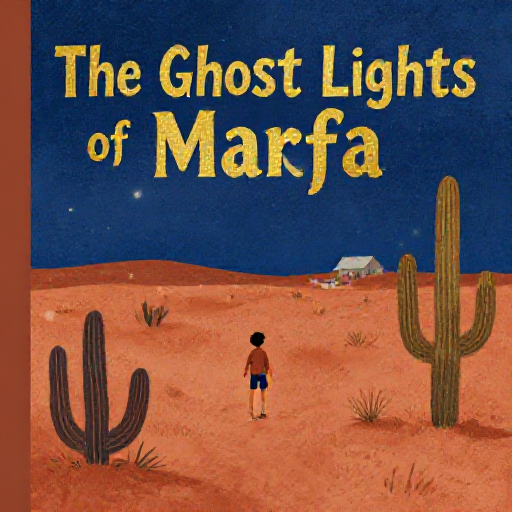
They appear east of town, out past the highway, where the desert opens up and there is nothing to get in the way.
No buildings. No towns until the mountains. Just the flat dark of the Chihuahuan Desert under a sky that has more stars than most people ever see in a lifetime.
The lights come on their own schedule. They might come three nights in a row and then disappear for six weeks. They bob and drift and split apart and merge back together. They are the color of candlelight, of headlights seen through fog, of something burning at a distance you cannot quite calculate.
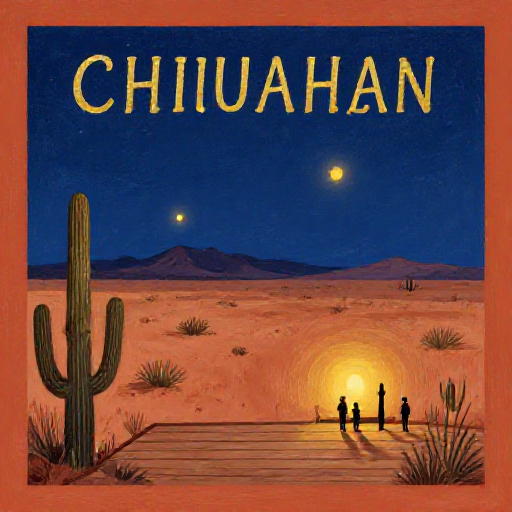
Thousands of people have seen them. Scientists have spent careers on them. A viewing platform has been built on US Highway 67, nine miles east of Marfa, with a plaque explaining that the lights have no explanation.
The plaque is accurate.
Chapter 2
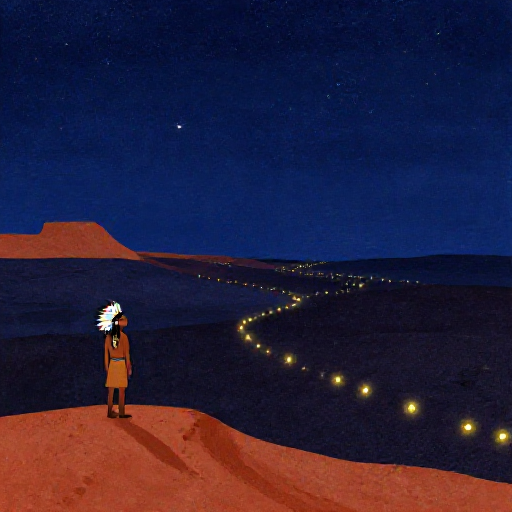
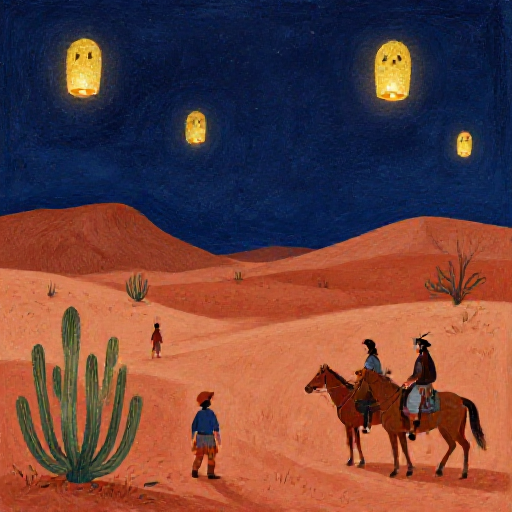
The Apache people, who knew this land long before anyone else named it, said the lights were stars that had come down to walk.
Not fallen stars. Not dying stars. Stars that had chosen to descend and move among the rocks and the dry grass and the creosote, for reasons that stars have that are not available for human inspection.
This explanation has the quality of all good explanations for things that resist explanation: it does not pretend to reduce the thing. It simply places it in a larger frame. The lights are not broken. They are not malfunctioning. They are doing exactly what they are doing.
The Apache did not fear them. They noted them the way you note something significant passing through a place you also inhabit.
When the Anglo settlers arrived in the late nineteenth century, they were less comfortable with the stars-walking explanation, so they began to look for other ones.
Chapter 3
The first written record in English is from 1883.
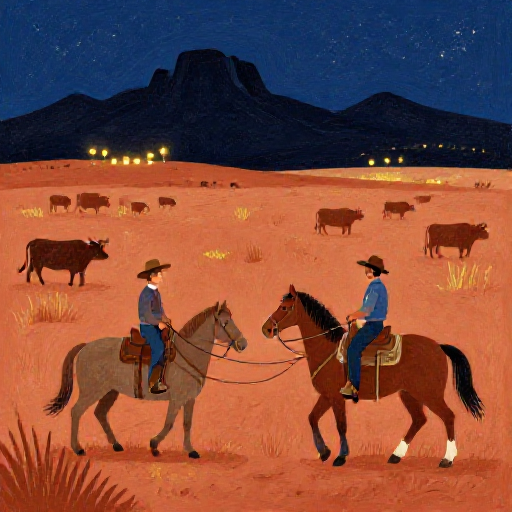
A cowhand named Robert Reed Ellison was driving cattle through the Mitchell Flat east of the Chinati Mountains when he saw lights flickering in the distance. He thought they were Apache campfires. He mentioned them to other ranchers. They had seen them too, had also assumed campfires, had ridden out to investigate and found nothing: no ash, no disturbed ground, no footprints.
Ellison's account is cited as the first Anglo documentation. It almost certainly was not the first time someone from that community had seen the lights. It was simply the first time anyone wrote it down.
Over the following decades, the lights became part of the landscape of the Presidio County basin in the same way the mountains and the silence were part of it. Something that was simply there, that the land included, that you accepted if you lived in that country long enough.
Chapter 4
The legends accumulated the way legends do in isolated places where strange things happen and there are long winters for talking.
Conquistadors, people said. Spanish soldiers who had come into this country four centuries ago and never found their way out. Their lanterns still moving through the mesquite, still searching for the silver they had been told was somewhere in these mountains.
Apache warriors killed in the conflicts of the nineteenth century, still riding the territory they had defended.
Ranchers found dead far from their horses with no mark on them and no explanation anyone could agree on. People who had walked out into the desert in the night for reasons unknown and were simply gone by morning.
Each legend shares a shape: the lights are something that was lost here and has not stopped moving.
The desert does not give things back. It keeps them and lets them wander.
Chapter 5
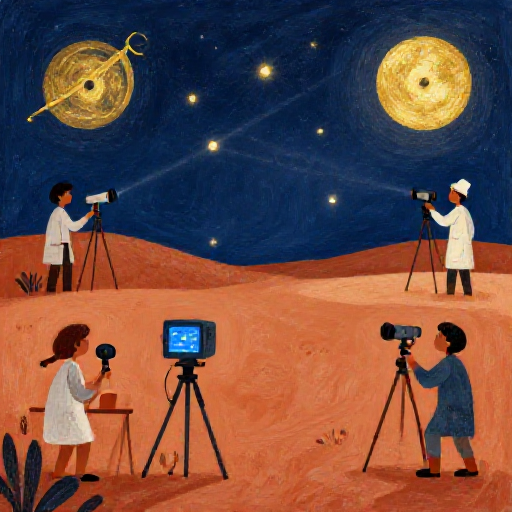
Scientists have been trying since the 1970s.
The Marfa Lights have been studied by geologists, atmospheric physicists, and optical engineers. A group from the University of Texas at Dallas published a study in 2004 proposing that car headlights on US 67 create a mirage effect under certain thermal inversion conditions, producing hovering lights in the middle distance.
This explanation accounts for some of what people observe.
It does not account for all of it.
Specifically, it does not account for the nineteenth-century sightings, which predate automobiles by several decades. It does not account for the lights that appear on nights when no vehicles are on the highway, which has been documented by observers who checked both simultaneously. It does not account for the lights that split apart, change color, and move in patterns that headlight mirages do not replicate.
The scientists who have studied them longest tend to say the same thing: there is something here we have not fully explained.
Chapter 6
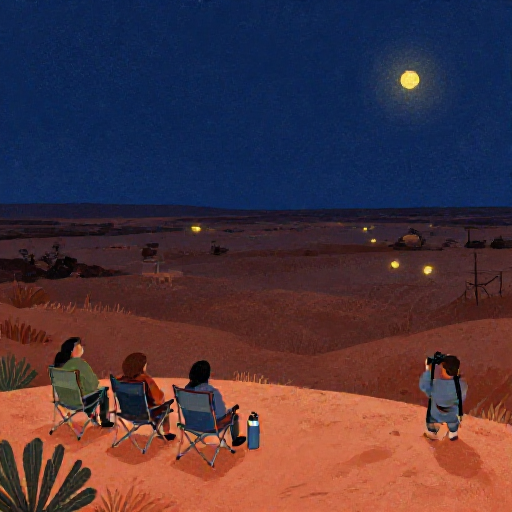
The viewing platform is open every night.
People come from everywhere now, set up chairs and cameras and long lenses, drink coffee from thermoses and wait in the cold desert air. Some see nothing. Some see something they spend years thinking about.
The lights, when they come, do not perform for the audience. They do not get closer. They do not respond to headlights flashed or shouts sent out into the flat dark. They simply move in their own slow way, by their own logic, through a country that has held them for as long as anyone has been paying attention.
Apache warriors. Lost conquistadors. Ranchers with lanterns still looking for the path back.
Or stars, descended to walk, for reasons that are not ours to know.
The desert east of Marfa holds very still.
The lights appear when they appear, and they do not explain themselves to anyone.
The True History
The Marfa Lights are a documented phenomenon in the Chihuahuan Desert near Marfa, Texas, in Presidio County. They have been observed continuously since at least the 1880s and are well-attested in newspaper accounts, scientific literature, and oral history. The Mitchell Flat viewing area on US Highway 67 east of Marfa is a permanent public installation maintained by the Texas Department of Transportation, and the lights are referenced in official state tourism materials. Multiple scientific investigations have been conducted, including a study by the Society of Physics Students and a more extensive University of Texas analysis in the early 2000s. None has produced a complete and universally accepted explanation.
The 2004 UT Dallas study proposing a headlight mirage hypothesis, conducted by atmospheric scientist Karl Stephan and colleagues, received significant media attention and is frequently cited as a "solution" to the mystery. Stephan himself was careful in the paper's language, noting that the mirage hypothesis explained a subset of observations and that other observed characteristics of the lights remained outside the model's scope. The pre-automotive sightings documented by Robert Reed Ellison and others in the 1880s and 1890s are well-established in local historical record and present a direct challenge to any automobile-based explanation.
Apache oral traditions regarding lights in the Chihuahuan Desert are not extensively documented in the academic literature, as much of this knowledge was transmitted orally and disrupted by the displacement of Apache communities in the late nineteenth century. Accounts of the Apache relationship to the lights have been collected by regional historians and journalists but should be understood as partial and mediated. The cultural geography of the area includes documented Apache presence stretching back centuries, and the Mitchell Flat region was within territory contested in the conflicts of the 1870s and 1880s. The lights have been observed in the same general area, consistently, across the entire span of documented observation.